Friday, December 9, 2011

It's Hammer Time

A selection of snowball hammers.
Did you know that Shelburne Museum has one of the largest collections of snowball hammers in the nation? Do you even know what a snowball hammer is? I definitely did not before I started working here.


Snowball hammers, also known as snow knockers, are used to remove excess snow and ice from horseshoes. Most hammers are made of iron and often have snap rings or hooks that can easily clip onto a horse's harness.


Our snowball hammer collection includes many varieties from early America. Blacksmiths gave snowball hammers, like the ones featured on the left, as gifts to customers. The hammers served as small tokens of appreciation for their loyal business, as well as a way for blacksmiths to practice and demonstrate their skills.


Recently, I traveled to some co-workers' houses to groom their horses and further investigate snowball hammers. While iron hammers like the ones in Shelburne Museum's collection are not often used today, you can definitely see how they would come in handy.

Habibi models a snowball stuck in her horsehoe.
Snowball hammers: Yet another example of the wonderful things you'll find at Shelburne Museum!
Sandy Sock's hooves are snow free!

Wednesday, December 7, 2011

Looking into the Light

Have you been considering using LED (light emitting diode) bulbs for your home or business? This rapidly-developing class of lighting fixture has generated quite a buzz. Since we've been researching and using LED bulbs in some of our galleries for about eight years now, other museums and collectors have been asking us if LEDs might be right for them too.
LED lights have illuminated the dollhouses and cases in the Variety Unit since 2004
Finding an exhibition design solution.
In 2004 Shelburne Museum installed LED lights in the Variety Unit's doll and scrimshaw cases primarily to solve an exhibition design challenge. While we'd prefer to keep lights out of the cases entirely, it just wasn't possible to light the objects from outside the cases given the relatively low ceilings in this 1835 building. The qualities we were looking for were: no ultraviolet content, low heat and even light. Director of Preservation and Conservation Rick Kerschner looked at a number of options and tested the most promising ones in a mock-up dollhouse room in the Conservation Lab.

Our mock-up dollhouse room with the monitor and some of the lighting options we considered
If you're interested in the details, he outlined his process in a presentation at the New England Archivists Meeting at Simmons College in 2008, now available as a podcast.

Ultimately, Rick settled on LED bar lights from Prolume. There were several reasons for selecting this company. Their bar-shaped fixture was a size and configuration that met our needs. The small company was also willing to create a light that was the appropriate color (3000 degrees K) and intensity to show off the collections to their best advantage. In addition, Prolume guaranteed that there would be no significant drop-off in the amount of light emitted from these bulbs for 10 years and that the light would not decrease by more than 50% for 15 years. Unfortunately this first generation of LED lights didn't live up to the estimated longevity and lost most of their light after only a few years of use. Prolume honored their guarantee and replaced all of the lights with their third generation LED bar lights containing diodes manufactured by Nichia. These new LED fixtures have been in place for over three years, and we have seen no loss in light intensity.

Note the differences in color among the first generation LEDs (top) versus the third generation LEDs (bottom). The diodes on the bottom are more uniform in color in contrast to the lights on the top. Its subtle, but it makes a difference.
So how many museum professionals does it take to screw in a light bulb?
In fall, 2010, Efficiency Vermont offered the museum a sweet deal - a full rebate on all the LED lights we cared to purchase (but only until December 31, 2010)! While conservators love free stuff just as much as anyone else, there were questions about the nature of the light emitted by LED lamps as compared to the more commonly used incandescent and halogen lights. We needed to know whether the light generated from the LEDs would be any more damaging than the light generated by the halogen lamps we were used to. Additionally we wondered if commercially available LED lights had the same color and intensity consistency that Rick had been only able to achieve for the Variety Unit cases by working directly with the manufacturer.

So as other institutions, including the National Gallery in London and the Getty Conservation Institute, were looking at commercially available bulbs in their labs to determine how the nature of light generated by an LED compared to fluorescent and incandescent lamps, Rick did some practical research in our galleries. He mocked up up comparisons and showed them to the electrician, exhibit designer, curators, director, and anybody else who had an interest in how the buildings were lit. Although Rick paid close attention to the color rendering index (CRI) of the LEDs, in the end, what was most important was how the artifacts actually appeared under the lights. Informed by the research done at other institutions and our own mock-ups, Shelburne Museum staff decided that the Philips EnduraLED MR16 and Sylvania UltraLED PAR 20 and PAR 30 LED replacement bulbs worked best for responsibly displaying our collections in our buildings with low ceilings.

Rick Kerschner, Exhibit Preparator Doug Oaks and Electrician Rick Gage have been generally pleased with the performance of these bulbs over the 2011 season. In total Shelburne Museum received over $50,000 worth of bulbs through Efficiency Vermont's "free LED" program. Rick estimates the yearly energy savings to be about $6,000; so payback will take about 10 years. Although the bulbs are rated for about 40,000 hours (or slightly more than 32 Shelburne Museum seasons) Rick is not convinced they will last that long. It remains to be seen how cost effective these bulbs really are.

More links to sources of information about using LEDs for exhibition lighting can be found on the American Institute for Conservation's website and within the LinkedIn Museum and Art Gallery Lighting discussion group. The Getty Conservation Institute's Guidelines for Selecting Solid State Lighting for Museums is available on request from their website.

Wednesday, November 30, 2011

The Turkeys Here Are Alright

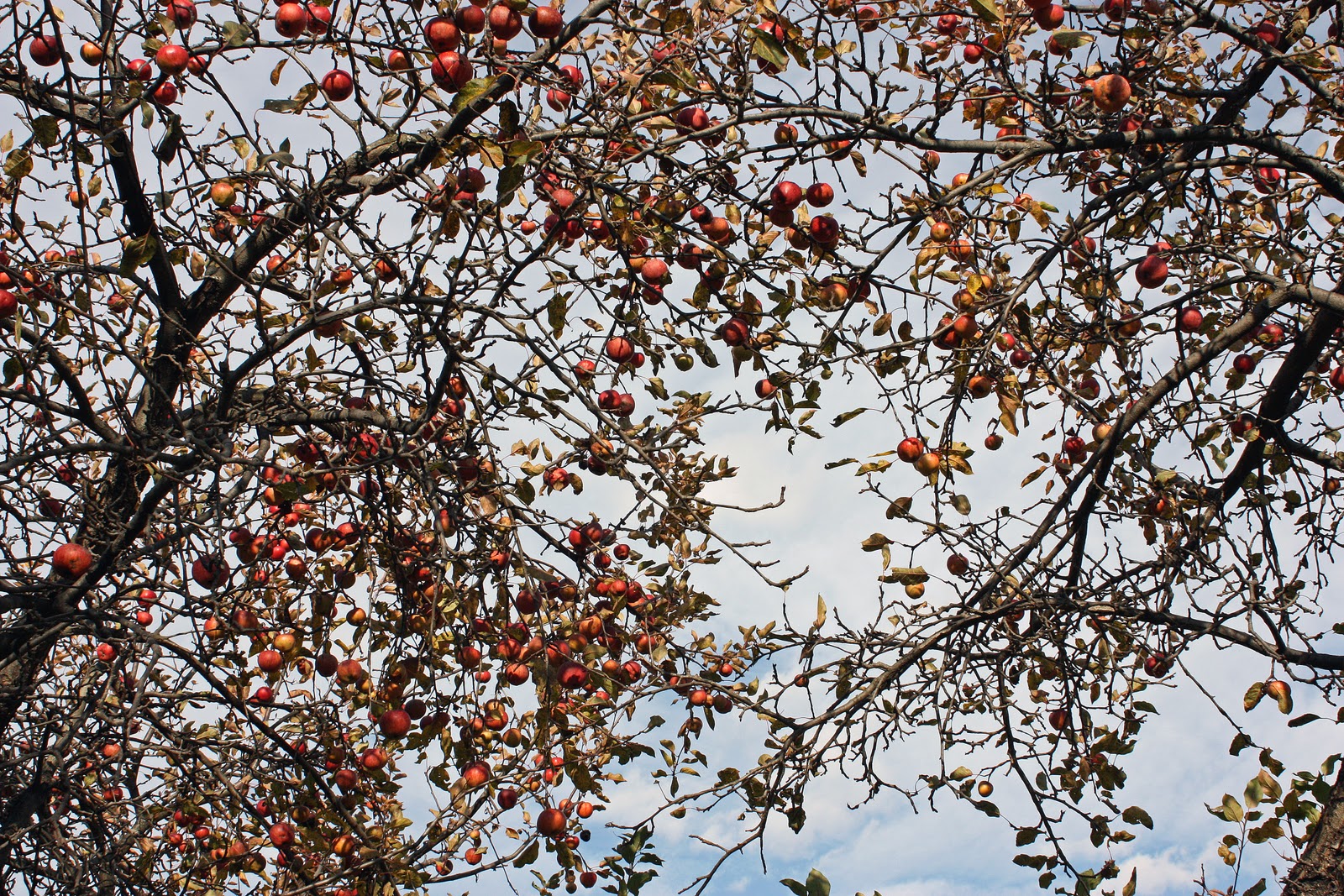
Our abundant apple trees: just another perk of the Museum's beautiful landscape in autumn.
Recently, I took a quick walk around the grounds on a sunny morning to do a bit of exploring and brainstorming. Although we're officially closed for the 2011 season, everyone around here continues business as usual. We've been preparing for the long winter ahead and yes, planning for next year already. This season was certainly memorable and excellent in many ways, and we thank everyone who made our incredible exhibits possible. We also would like to thank all the folks who came to visit and explore the museum throughout the summer!

Speaking of giving thanks, I stumbled upon something during my walk that is utterly appropriate to commemorate the holiday we just celebrated. It has to do with this building, the Horseshoe Barn. Look closely and maybe you'll see what I mean:
View of the barn: constructed here on the grounds from 1947-1949.
Take a closer look.
Yes, our folk art collection includes representations of the infamous turkey! Traditionally, Thanksgiving turkeys might appear on your dinner table but our sculptural examples live proudly on the exterior of the barn.

Gobble gobble...
This pair of turkeys is very similar to (and perhaps based off of) another pair of carved objects we have in the collection. The original folk art carvings are made from pine and coated in gesso and gilt paint:

27.FM-29 a-b; Pair of Turkey Carvings
Our turkey collection doesn't stop at folk art, however. We've also got some Audubon prints that are similarly themed:

1958-311.1; Wild Turkey by John James Audubon
 And here's another one, also by Audubon:

1958-311.2; Wild Turkey by John James Audubon
Of course, this season isn't just about the Turkey and the shopping deals. On behalf of the museum, we hope everyone enjoyed a safe and restful holiday.

...and possibly a few slices of some fresh apple pie.

Friday, November 4, 2011

Meet The Maker!

Recently, Monica and I have been cataloging furniture over here in Collections Management. If you visited the museum this past season, you may have seen the exhibit entitled Something Old, Something New: Continuity and Change in American Fine Furnishings from 1700-1820. This exhibit displayed a wonderful selection of some of our finest high-style furniture pieces. However, we've got a lot of great furniture in our collection that isn't part of this particular exhibit--much of it is also on view in our historic houses!

As I was working on the table collection, I came across this lovely little piece:
Mahogany Table by Nathaniel Jillson (3.6-152), ca. 1840
This small table was made in the 1840s by Nathaniel Jillson. The wood is mahogany and the table is finished with veneer. It has a four-legged pedestal base and a shallow "apron" around the top. The maker, Mr. Jillson, lived and worked in Williamstown, Vermont. He was born in 1797 and died in 1878. Small tables like this one were of great use during the 19th century, especially ones that could be easily picked up and moved from room to room. Apparently they were called "tavern tables" in some regions.

I wondered about Mr. Jillson and his furniture business. As it turns out, I didn't have to look too far to learn a little bit more about him--here at the museum we also have his portrait!
Portrait of Nathaniel Jillson (27.1.1-222) by Keane West Davis
I happened upon Nathaniel himself as I worked with our paintings collection one morning. I was so excited to see the person who crafted one of our furniture pieces. This painting was made in 1844; Nathaniel was 47 years old at the time. Our records show that the census in the mid-19th century listed Mr. Jillson as a furniture and cabinet-maker in Williamstown. The portrait-painter, Keane West Davis, also lived in Williamstown and he also painted Mr. Jillson's second wife, Amanda: 
Portrait of Amanda Ervilla Bacon Jillson (27.1.1.223) by Keane West Davis
According to the information we have about the Jillsons, Nathaniel also made the wooden frames for these two portraits. Seems like he was a man of many talents!

Tuesday, October 25, 2011

Art at Hand

October is the ninth annual Art Beyond Sight awareness month, which strives to increase access to the so-called "visual" arts for people who are blind. Through programs like Art at Hand, a pilot program at the museum for visitors who are blind and visually impaired, the museum world is exploring how art encompasses far more than the eye can see.

As Betsy Zaborowski, a representative for the National Federation of the Blind, has described, a blind person's white cane has the power to inspire "a lot of assumptions...and a lot of discomfort" in others. One of these longstanding assumptions is that people who are blind or visually impaired cannot appreciate or enjoy museums.


That stigma, however, is gradually disappearing. Due in large part to the commitment and encouragement of nonprofits like Art Beyond Sight and VSA-Arts as well as the National Endowment for the Arts, institutions across the country, including Shelburne Museum, are finding creative ways to make their collections accessible to this community. Educators are bringing art vividly to life using detailed verbal descriptions, tactile materials, sounds, and smells.

During Art at Hand's pilot season, we have offered five tours and tested a combination of strategies to capture the essence of works of art for people who may not be able to see them. In one instance, museum guide Lee Dowling presented Manet's Blue Venice. She first spoke about the colors and texture of oil paint, the dimensions of the work, and the subject matter, and then continued with a sensory description--based on her own travels--of Venetian canals filled with murky waters and spirited gondaliers. On another tour, guide Elizabeth Sabens clipped fresh herbs, including chives and lemon thyme, from the Hat and Fragrance garden as an introduction to quilting and methods of quilt preservation.

Perhaps our most memorable moment yet was a tour of the Circus Building. Guide Georgia Pendleton brought in fresh hay to capture the atmosphere of life under the Big Top, and we received special permission for the group to feel the museum's wood-carved Dentzel carousel horses. Finally, we brought them outside for a ride on our operating carousel. One visitor wrote to us: "The best part was the Merry-Go-Round ride. It brought me back to when I was a child and could see."

Friday, October 7, 2011

Preparing for Haunted Happenings

October is finally here, and I’m still having difficulty choosing my costume for Shelburne Museum’s eighth annual Haunted Happenings event. This is no light matter, as this year’s theme demands a serious, soul-searching investigation of whom to best represent from one of our culture’s most celebrated clan of characters. Yes, I’m speaking of Superheroes.


Children of all ages and abilities will fly down to the Shelburne Museum for Haunted Happenings on October 30th to take part in some super-amazing activities, such as testing one’s Superhero powers and visiting Batman’s bat cave.

Choosing a character is always a fun time for museum staff. Katy Kreiger, the museum’s administrative assistant, chose Poison Ivy – a hippie ecologist turned Batman villain, who uses plant toxins and mind-controlling pheromones to snuff out her enemies. When asked why she chose such a character Katy replied, “ Is she really even a villain? All of her activities are based on protecting the environment. Like Poison Ivy, I’m a total hippie…I think I can bring a nice positive spin on her.”


Preparations are well underway for Haunted Happenings. Renee Compagna, Family Programs Coordinator, founded the Haunted Happenings concept back in 2004, and works hard to come up with fresh ideas each year – making it one of the most popular events of the season. “Last year was our most attended Haunted Happenings to date,” Renee remembers, “even though we had the worst weather ever.” The rising popularity is perhaps owed to the creative activities that compliment past themes such as Saturday Morning Cartoons, Board Games, and Wonderland. “We’ve done themes for the past four years. It gives the different departments direction and helps us when decorating the exteriors of buildings,” Renee says.


So why did Renee choose Superheroes for 2011? To this she simply replies, “I thought that it would be a lot of fun. And, what’s better than seeing your coworkers in tights and fake muscles?”

But the real Superhero work is making sure that every child participating in this year’s Haunted Happenings receives twenty pieces of candy or trinkets. “It’s a science – I have it down to the last piece,” Renee asserts. Shelburne Museum’s mailroom will not see an end to the shipment of the large and heavy boxes of sweet stuff until Renee gets exactly 40,000 pieces.

And where is she storing these boxes for the time being? Curatorial Fellow Sara Woodbury types away at her computer while the mountain of candy boxes looms over her. When Renee asked if she could store the boxes in the space, Sara replied, “Sure not a problem. It would be a good chance to work on my willpower. Besides they’re Skittles. It’s disgusting. If it was chocolate it would be an entirely different story.”


Have you decided what you’re going to be for this year’s Haunted Happenings? After carrying three boxes of candy one afternoon, I had no hesitation declaring that I will be Wonder Woman.

Haunted Happenings is 10 a.m. to 1 p.m. on Oct. 30. Admission is $5. Children under age 2 and under are free.

Wednesday, September 28, 2011

Caring for your Heirloom Quilts

We get inquiries in the conservation lab fairly often about how to hang heirloom quilts. Director of Preservation and Conservation Rick Kerschner wrote up these suggestions a few years ago and we've been distributing them on request.

I have a few cautions about mounting quilts on the wall. Once a quilt is mounted on the wall, it tends to stay up for a long time. Most textile conservators recommend limiting exhibition to 6 months to a year. At Shelburne, we take our quilts down every few years (we are only open 6 months a year) and rotate new ones onto display. I would encourage homeowners to also implement some reasonable schedule to rotate a quilt back to storage for at least an equal amount of time that it is being displayed. In general, we prefer to cover our quilts with Lexan (polycarbonate), Mylar, or Melinex whenever possible to protect them from dust and handling. I am sure that you probably have good filters on your furnace to filter out dust, but dust that is kicked up from the floor that never makes it into the HVAC system can still be a problem. For that reason, I would recommend that the bottom of the quilt be at least 2 feet above the floor.


Cleaning a quilt that has been hanging
1.Obtain a piece of plastic window screen and bind the edges so that they will not snag the textile.
2. Lay quilt flat.
3. Place the window screen on top of the quilt and, using a brush attachment on a HEPA vacuum with suction control set to low suction, vacuum both sides of the quilt. Avoid rubbing the brush attachment against the screening.

Vacuuming a quilt through a screen
Light and your quilt
Be sure to mount the quilt away from daylight, not just out of direct sunlight from a window, but away from any significant window light. Actually, the highest light levels are recorded in a home during the winter when the sun is low in the sky and can shoot in windows, and when there is snow on the ground to reflect the light into the house. Daylight will fade certain dyes on antique quilts very quickly, and can cause deterioration to fibers on fabrics that contain metal based mordants (iron-based mordants are found in brown-dyed cotton fabrics of the late nineteenth century). It is fine to light the quilt with track lights, but they should be mounted well back from the quilt (about 5 feet) and low wattage wide floods should be used to illuminate it (35 to 50 watt tungsten floods are best - the old fragile looking frosted kind, not the newer halogen lights, as they have too much UV radiation). If you can feel any heat on the back of your hand when it is held in front of the quilt, the lights are too close. It is better to try to get a low, even light on the entire quilt using several floods than to use one or two bright halogen bulbs and have too much light in some areas and a spotty appearance. It would be best if the light track could be on a separate switch so that it can be turned off without making the entire room dark.

Check with a conservator in your area for additional advice and ask to have light levels measured for the final installation. A conservator can be located through the American Institute for Conservation Referral Service.

Displaying quilts
Finally, there are other ways to display heirloom quilts:
1. Lightly folded at the bottom of a bed
2. Draped over a wide tube (6" diameter or more) mounted parallel to the wall (this displays half the quilt at a time and the quilt can be easily turned so that the other side is exposed to the "elements." No Velcro or other mounting mechanisms are required for this display method).
3. Very fragile and precious quilts are usually lightly folded in long and narrow acid-free storage boxes that can be stored under a bed or on a high closet shelf and brought out only occasionally for special guests. 

There are a number of other good resources on caring for heirloom textiles available on the internet. In particular, there are good general guides to caring for textiles on the American Institute for Conservation's website and the Textile Museum's website. The Philadelphia Museum of Art shares some of their techniques for storing historic garments and accessories on their site and the Minnesota  Historical Society shares their tips for storing flat textiles in boxes.