Showing posts with label Exhibits. Show all posts

Friday, November 16, 2012

Shelburne Museum Does NEMA

Recently Burlington hosted the 94th annual New England Museum Association (NEMA) conference. Staff from Shelburne Museum participated in several sessions on a wide range of topics from new building construction to LED lighting.

Paige and I co-chaired a panel discussion called, "Open Doors, Open Minds: Serving Special Audiences on a Budget," in which we spoke about Art at Hand, our tours for visitors who are blind or visually impaired, and Mornings at the Museum for people with Alzheimer's. We also worked with Paula Rais, Director of Community Engagement at the Children's Museum of New Hampshire. She runs Exploring Our Way, an acclaimed program for children with Autism Spectrum Disorder. Paige and I are both "Emerging Museum Professionals" or EMPs; we haven't been in the field very long, and neither of us had been to a professional conference before. Chairing a session was a true honor, and we had been preparing for it for almost nine months!


It began back in February with a call for proposals. This year's conference theme was "Pushing the Envelope: Innovation and the Future of Museums." We knew the special audiences we serve are quite unique; many institutions are just beginning to explore their potential. We also recognized that some of the museums well known for their array of accessible programming, such as the Metropolitan Museum of Art and the Museum of Modern Art, have a designated "access coordinator" and corporate sponsors who facilitate and fund their tours. We wanted to show smaller institutions with more limited resources that they can offer meaningful programming to audiences with special needs.

Mornings at the Museum

Art at Hand
Throughout the spring and summer we coordinated with Paula, outlining our session and elucidating some general principles we've all learned. They included:
  • Assembling a team of advisors who are experts in the audience you are engaging
  • Soliciting feedback at every point in the process
  • Seeing special tours and programs as stepping stones to individual museum visits; anticipating and encouraging participants to return on their own.
When the day of our presentation finally came, we were thrilled to share our experiences with forty fellow museum professionals looking to start their own access programs. We fielded questions on everything from wheelchair guidelines to staff training. I found it empowering to share both the highlights and the challenges of these programs, and came out with new energy and excitement about our special tours--which was well worth the time spent. Thank you, NEMA 2012!

Thursday, September 13, 2012

New Faces in Education

If you've been following Shelburne Museum on Facebook, Twitter, Flicker, or Youtube, you know that this is an exciting time here as the Museum builds a Center for Art and Education that will transform the Museum from seasonal to year round operation. With each steel beam that goes up, fresh possibilities arise.

We're very excited to bring on board two new faces who contribute to the positive energy and forward momentum that the promise of a year-round Shelburne Museum brings. Meet Daphne and Kim! Both began jobs in the Education Department this month.
Daphne Zencey, Academic Programs Coordinator

Daphne Zencey is the Museum's new Academic Programs Coordinator. She comes to us by way of the University of Vermont and Syracuse University, where she earned her master's degree in art history. She is also a veteran of the United States Coast Guard. This spring Daphne worked as an educator for Passport to Learning, our series of interactive workshops for grades K through 8. Her favorite session was "Shop 'til You Drop" at the General Store. She loved giving students a shopping list, items to barter, and a limited amount of play money and watching the "spontaneity and hubbub" that ensued. Daphne is looking forward to seeing school-aged kids on the grounds this fall, especially the littlest ones on their very first visit to the Museum who can't help but "gawk at everything around them."

A self-described "19th-century nut" who remembers the excitement of visiting the Metropolitan Museum as a child, Daphne adores European painting and completed her master's thesis on the Pre-Raphaelites. She also has a soft spot for decorative arts such as those at the Variety Unit, especially the unique collection of sailor-carved scrimshaw. An artist herself, Daphne likes to work with pastels and charcoal. "I dabble," she explains. We know her passion for art and hands-on experience will make an impact as she takes on the Academic Programs Coordinator position!

Kim McCray, Adult Programs Coordinator
Kim McCray is Adult Programs Coordinator. She has significant experience in the museum world with positions at the Smithsonian's National Postal Museum and the Nantucket Historical Association under her belt. She is currently working on a doctorate in museum education at Lesley University, having completed her undergraduate degree at St. Michael's College and her master's at Georgetown University. Her interest in museums goes back much farther. A lifelong Vermonter, she recalls a visit to the Fairbanks Museum in St. Johnsbury at age five to see dinosaur fossils as well as childhood trips to Shelburne Museum. 

As a young girl, Kim's favorite piece in the Museum's collection was Tinkle, a folk art painting of a proud-looking white cat completed in 1883 by an unknown American artist that visitors can view today in Stagecoach Inn. It still stands out to her, she explains, because Tinkle was important enough to his owner for him or her to commission a portrait. Kim's interest in American Folk Art spans many mediums, from paintings to whirligigs, but she is always inspired by stories of the unique individuals who crafted the pieces. A novice quilter, Kim also enjoys creating herself. She is excited to become part of the Shelburne Museum community and have the opportunity to put lifelong passion and academic theory into practice as our Adult Programs Coordinator.

Welcome, Daphne and Kim!

Monday, July 16, 2012

Looking Beyond Sight

The following is a guest post written by Shelburne Museum member Shirley Katz. She and her husband, George, attended an Art at Hand tour for museum visitors who are blind or visually impaired. Here's what she had to say about their experience: 

The Lions Club sponsored a day at Shelburne Museum for the blind and visually impaired. It was a described, hands-on tour of two of the exhibits: The steamboat Ticonderoga and the Lighthouse.


The Ti is very impressive, now "docked" in a grassy basin on the museum grounds.

Museum guides provided replicas (or near-replicas) for everyone to get a feel for the boat. 


Then we boarded the Ti to hear an excellent visual description. The Ti was restored to appear as it may have looked in 1923. The cherry wood paneling and adornments are truly beautiful. As a sighted person, I appreciated this even more as we were invited to feel the detailing.

We even got a feel for what it may have been like to take the controls.


Back to the area just in front of the dining room, we learned more about this magnificent vessel. 

The floor here looks like a puzzle. The guides had a sample piece of what the flooring is really like.


Our guide also pointed out that the carpeting in the dining room looks like it is made up of tiny anchors--very appropriate! Can you see them?


The museum now has two magnifiers for visually impaired people to check out while on a tour. They were generously donated by Ai Squared, and this was the first day they were used. Here Geo is looking at the ceiling while also seeing it up close in the magnifier. 


We walked back for a tour of the Lighthouse before taking the shuttle back to the main entrance.   


Thank you, Shirley! We are offering three additional Art at Hand tours this season. For more information or to register, visit http://shelburnemuseum.org/learn/adults/activities-and-tours/tours-for-special-audiences/. 

Thursday, June 14, 2012

Teaching Shelburne Museum II: A Centennial Expo

A few weeks back I wrote about a partnership between Shelburne Museum, the Green Mountain Writing Project, and Turning Points in American History that encourages Vermont educators to use primary sources, including museum collections, when studying the Civil War and Reconstruction era. I promised to share more about the study group that meets at the Museum, including innovative ways that participating teachers are engaging their students with history. I had to look no further than the 1876 World's Fair, which arrived at the Museum on a sunny day this spring.

"Lamb & St. Lawrence Leech Co.," presented by Vermont educators Jennifer Theoret (pictured) and Cate Lamb, advertised historical remedies in the Apothecary Shop.
The Turning Points educators modeled their Centennial Exposition after National History Day, a competition in which students study a historic topic using a variety of primary and secondary sources and present their research in the form of a paper, performance, exhibit, website, or documentary. Our educators set up temporary exhibits around the Museum grounds on nineteenth-century topics including needlepoint samplers, the history of footwear, and Civil War-era amputation. 

They brought to life several objects that I had seen before but never studied, such as this prosthetic leg on display at the Doctor's Office upstairs in the General Store. I learned that amputations were increasingly common in the Civil War as a result of military advancements like the minie ball, a particularly destructive lead bullet used by the Union army. The Turning Points teachers also made compelling connections, as in the needlepoint display that linked the content of early American samplers to the unique roles that women played in the abolitionist movement. I was surprised to discover that explicit anti-slavery inscriptions appear on textiles dating as early as the 1830s.
A prosthetic leg at the General Store.
Each exhibit included a detailed lesson plan relating to the content of the exhibit to the elementary, middle, or high school classroom. My visit to the 1876 World's Fair was a unique opportunity to see Shelburne Museum's collection from a different angle, and it opened my mind to ever-new teaching possibilities. Stay tuned for a post about the Green Mountain Writing Project's role in this unique collaboration. Thank you, Turning Points!

Friday, November 4, 2011

Meet The Maker!

Recently, Monica and I have been cataloging furniture over here in Collections Management. If you visited the museum this past season, you may have seen the exhibit entitled Something Old, Something New: Continuity and Change in American Fine Furnishings from 1700-1820. This exhibit displayed a wonderful selection of some of our finest high-style furniture pieces. However, we've got a lot of great furniture in our collection that isn't part of this particular exhibit--much of it is also on view in our historic houses!

As I was working on the table collection, I came across this lovely little piece:
Mahogany Table by Nathaniel Jillson (3.6-152), ca. 1840
This small table was made in the 1840s by Nathaniel Jillson. The wood is mahogany and the table is finished with veneer. It has a four-legged pedestal base and a shallow "apron" around the top. The maker, Mr. Jillson, lived and worked in Williamstown, Vermont. He was born in 1797 and died in 1878. Small tables like this one were of great use during the 19th century, especially ones that could be easily picked up and moved from room to room. Apparently they were called "tavern tables" in some regions.

I wondered about Mr. Jillson and his furniture business. As it turns out, I didn't have to look too far to learn a little bit more about him--here at the museum we also have his portrait!
Portrait of Nathaniel Jillson (27.1.1-222) by Keane West Davis
I happened upon Nathaniel himself as I worked with our paintings collection one morning. I was so excited to see the person who crafted one of our furniture pieces. This painting was made in 1844; Nathaniel was 47 years old at the time. Our records show that the census in the mid-19th century listed Mr. Jillson as a furniture and cabinet-maker in Williamstown. The portrait-painter, Keane West Davis, also lived in Williamstown and he also painted Mr. Jillson's second wife, Amanda: 
Portrait of Amanda Ervilla Bacon Jillson (27.1.1.223) by Keane West Davis
According to the information we have about the Jillsons, Nathaniel also made the wooden frames for these two portraits. Seems like he was a man of many talents!

Monday, September 19, 2011

The Guides Do Lunch


Shelburne Museum Guide Alice Thomas
While winding down from summer camps and gearing up for school programs, we (Paige and Angela) thought we would check in with the guide staff. Museum guides, stationed in twenty-five of our thirty-nine buildings, field a range of visitor inquiries. We knew we’d find a few of them enjoying lunch in the “Staff Only” section of the Museum Café, and on a recent afternoon, we sat down with Bill, Beth, Alice, Ellie and Hilda for a lovely meal.

Though curious at our arrival, they continued to reach into their plastic bags and containers of sandwiches, fruits, and other treats. To spark a friendly conversation, we asked them, “Has anything neat happened so far today?”

The guides told us that there was an English family and a German couple on the grounds. Alice took this as an opportunity to share the time when a group from the Middle East visited the museum. They went up to her husband Gerald, also a guide, and he surprised them all with his fluent Arabic. Alice explained that she and Gerald spent three years at the American naval base in Tripoli, Libya during the 1970s. She recalled the beautiful city and the warm weather; but above all, she recalled the male attention she used to receive in the marketplace. “They used to pinch you. If they thought you were good looking you could count on a pinch.” We all let out a good laugh.

They spoke for a minute or two about guide classes. Guides supplement their own research with morning classes on topics ranging from the gardens on the grounds to social media and networking in the museum world. Beth Thorpe told us about a favorite class that taught historic fabric dyeing techniques.

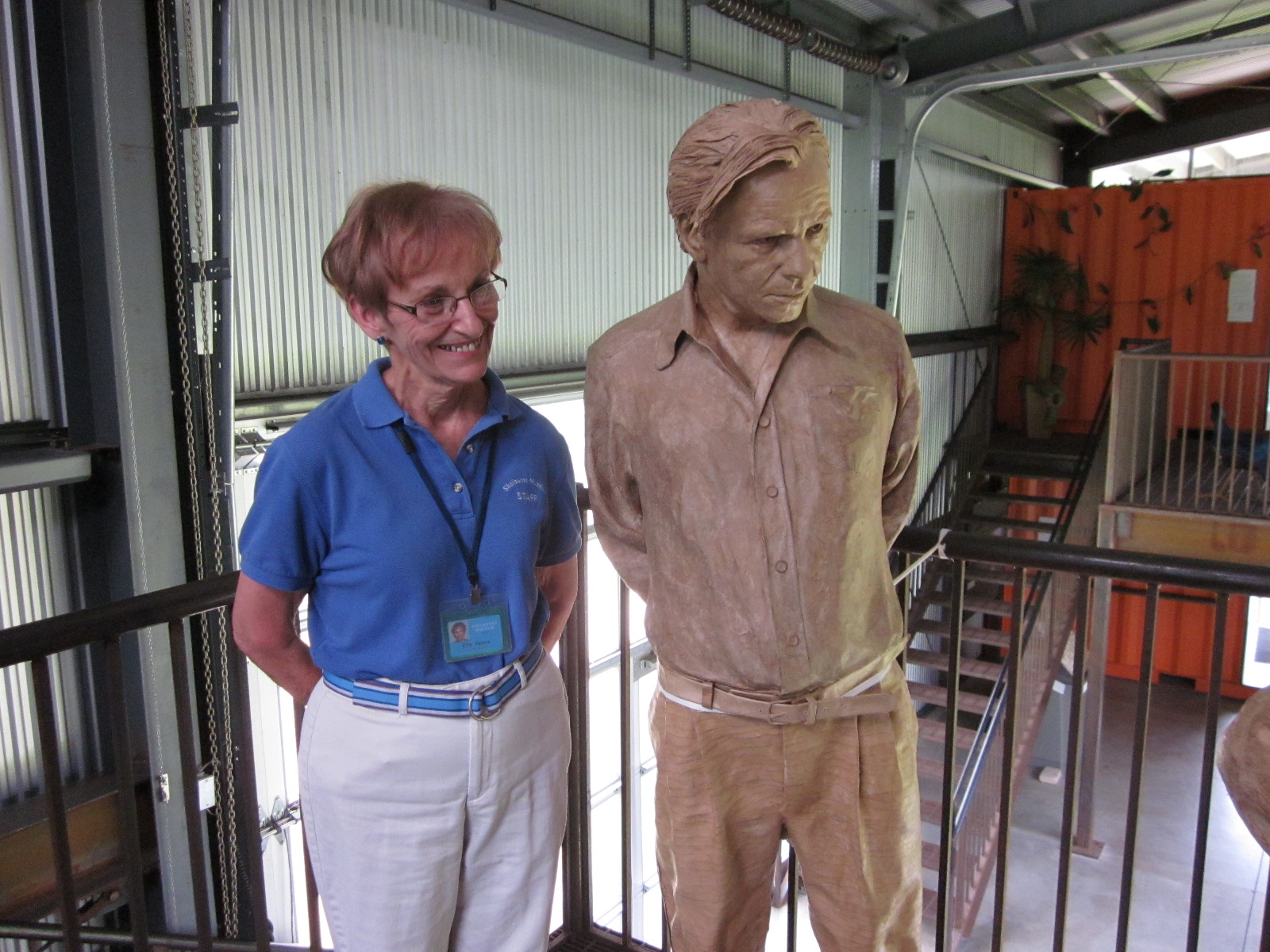
Shelburne Museum Guide Ellie Peters
The conversation then shifted to a frequent topic: how to best engage museum visitors. Ellie Peters enjoys asking children visiting the Stencil House which room is missing. It only takes a short investigation before they return with an answer: the bathroom! Unfortunately we don’t have the original outhouse associated with the home. Beth told us that many visitors immediately like Kalkin House, a modern gallery made of metal, glass and concrete. “They walk in and get visions,” she explains. Ellie chimes in, “They want to live there!”


Hilda said she was spending the day in Webb Gallery introducing visitors to In Fashion, our exhibition of 19th century and contemporary designer fashions. Beth leaned over conspiratorially to share that the best place to begin the daily gallery talk was in the “Complete the Look” room, which displays bodices from our collection paired with imaginative contemporary skirt designs by students at the Fashion Institute of Technology.

Shelburne Museum Guide Beth Thorpe
Then, like clockwork, the guides packed up their belongings and set off to return to their posts. Of course, they made sure to bid everyone a hearty goodbye and warm wishes for a happy afternoon.

Wednesday, August 3, 2011

Upcycle/Downcycle


Electra Havemeyer Webb laying out flattened hatbox panels in Hat and Fragrance Gallery, c. 1953

Upcycling: transforming a useless object or material into a product of better quality or use. Downcycling: converting a useless object or material into something of lower quality or use.

There’s no doubt that Shelburne Museum founder Electra Havemeyer Webb was ahead of her time in many ways. While she collected works made by everyday Americans, not all of those objects ended up being museum pieces quite in the manner we think of today. In fact, sometimes she found new uses for historic objects in her collection.

Let’s consider the hat and bandboxes. In Shelburne Museum’s collection, there are approximately 200 nineteenth-century oval lidded boxes made of wood or cardboard covered with block printed paper designed to store hats and other accessories. Mrs. Webb began collecting them early on.

"For years and years I collected hatboxes. I don’t know why, don’t ask me...I think they are so interesting in design and also I think they have great educational value," she said.

Certainly the collection contains some with great stories, such as “Peep at the Moon” as told by Curator of Design Kory Rogers:


“Peep at the Moon” retains its original form, but other hatboxes that Mrs. Webb collected found new uses. I haven't counted how many she flattened to create decorative paneling in two rooms in her home in Westbury, Long Island. Scalloped paneling in one room was constructed of yellow hatbox sides. The other room was produced from sides and lids of blue hatboxes. More panels from flattened boxes are on view in the Hatbox Room in the Hat and Fragrance Textile Gallery. She laid out the arrangement herself while the building was being constructed in 1953.


Mrs. Webb's yellow hatbox room in Westbury, Long Island


While preparing the collection during the renovation of the Hat and Fragrance building I noticed that some of the boxes had been flattened once and then returned to an oval shape later. Sadly, Mrs. Webb did not describe her criteria for conversion, but there are multiple versions of the same papers represented as both whole boxes and flattened panels.

Blue hatbox room in the process of deinstallation from J. Watson Webb's home in Los Angeles, CA, 2000.


When the Webbs moved from their Westbury residence, son J. Watson Webb, Jr. took the hatbox wall paneling - a blue room and a yellow room - and installed it in his home in Los Angeles. After his death in 2000, the paneling was donated to the museum and I was part of the crew who disassembled the paneling to send it to Vermont. Like previous Shelburne Museum workmen who moved historic structures to the museums grounds, we numbered and photodocumented the paneling as we removed it from the house.

As the conservator in the crew, my job was to record how the paneling was constructed and to ensure that the paper and moldings were sufficiently stable for travel. You’ll find the blue hatbox room panels on view in the Museum's Hat and Fragrance Gallery. But the yellow room? It became the top border and backs for the trivet cases in the Variety Unit, a decorative arts gallery next door to Hat and Fragrance. In creating these cases, the carpenters added new wood to the old and didn't alter the joinery in any way. If desired, the cases could be disassembled and reconfigured as paneling once again.

The yellow hatbox room in the Variety Unit, where trivets are on display, 2011.


Thursday, July 7, 2011

With a little help from my friends

At the recent American Institute for Conservation's annual meeting, I participated in a panel discussion, specifically to talk about how I, as an objects conservator, care for Shelburne's textile collections while two other conservators, a paintings conservator and an objects conservator who works primarily on African art and artifacts made of many different materials, both in private practice, discussed their approaches to the conservation of textiles.

Backing up a bit, my title is "objects conservator" which means that I work on three-dimensional works of art and artifacts. In my graduate school work at the University of Delaware/Winterthur Museum program in art conservation, I cycled through courses focused on the science, history, and conservation of the world of object and material types: paper, photographs, textiles, paintings, wood and furniture, metals, leather and other organic materials, ceramics, stone, glass....and at Shelburne the collections demand that I draw on the full range of what I was taught. But really, there's more to all of this than anyone could learn in just three years of graduate school, and so I continually build on that body of knowledge by reading, going to conferences, attending workshops, and talking to colleagues so that I can do my job in the most responsible manner possible.

The panel discussion is summarized on the American Institute for Conservation's blog, and mostly I talked about the various kinds of collaborations I enter into with conservators who specialize in textiles, as well as volunteers, in order to care for the museum's quilts, hooked rugs, clothing, and upholstered furniture collections.

Recently, though, I entered into a new kind of collaboration, one with an artist/designer, the results of which are on view in In Fashion.

The hats in In Fashion were a whole lot of fun to work with. The pieces in the show from Shelburne's collection run the gammut of materials: straw, glass, plastic, ostrich feathers, reed, silk...even pipe cleaners. I mended broken feathers and made replica gems to replace missing ones. And as fabulous as the pieces from our own collection are, the pieces made by Don Marshall on loan from designer Susan van der Linde are fantastic, in that mythical Pan's Labyrinth kind of way. How were designer/preparator Doug Oaks and I going to show off these amazing but incredibly fragile works of art off to their best advantage?


Hat by Don Marshall being test fit to the mount in the conservation lab

Fortunately Susan van der Linde had already come up with a marvelously elegant solution for her own hats. Designed by the architecture firm Bade Stageberg Cox, the mounts that Susan uses in her own showroom were exactly the kind of solution we were looking for. Described as a surrealist twist on the milliner's head mold, the mounts are made of intersecting pieces of painted plywood. Although these "heads" are smaller than a human head, their design offered opportunities.


Susan van der Linde's mounts with polyethylene foam wedges covered in surgical stockinette support this hat by François on a jaunty tilt


I saw that, when necessary, I could slot in supporting fabric covered wedges into her mount's design for Shelburne's 19th and early 20th century hats in the exhibition. The green silk and reed calash was especially fun. For this mount I built a variation of a storage mount used for this kind of hat at the Museum of Fine Arts, Boston that would slot on to Susan van der Linde's mount.

The modified wedge for the calash as it was being developed

So, thanks, Susan, for allowing us to use your mounts for the show. And thanks also to my colleagues for their willingness to help me think through some of the issues posed by the collections at Shelburne Museum.

Thursday, June 9, 2011

What's In Fashion at Shelburne Museum?

With the opening of In Fashion just around the corner, I thought it would be a good time to explore the varied fashion sensibilities of the Shelburne Museum staff. We all admire haute couture and celebrate the high styles of 1690-2011 in the upcoming Webb Gallery exhibit, but what goes on behind the scenes? Here's your inside look at the fashions of the people who keep the museum running.


Curator of Design Arts, Kory Rogers, loves his plaid and gingham. He tries to maintain a balance between comfort and class during his busy days at the office.


Education fellow Angela Pratt is queen of all things "clean and classic." Alice, one of our trusty guides, likes adding a little pizazz to her guide uniform with fashionable, bold eyeglasses. She purchased these frames with a little help from her friends and opthamologist.


Ben Phelps's work fashion is inspired by all of the delicious food in Shelburne Museum's Cafe. He has to wear his uniform when preparing and serving food, but always accessorizes his look with a smile.


Narda Carlson, our technology administrator, likes to wear bold colors that reflect her bubbling personality. This particular ensemble was picked up at a thrift store!


Practicality and safety dictate Building Care Technician Rob Zimmerman's wardrobe. Steel-toed boots and t-shirts from the museum store are staples in his everyday wear. If you're lucky, you can catch him wearing a large-brim straw hat that protects his fair skin from Vermont's hot sun.


Collections Management fellow Kelsey Adams likes to create fun fashion combinations by pairing different colors and patterns. She is a bargain diva and finds most of her wardrobe wonders at discount and thrift stores.


Keep your eyes peeled for Shelburne Museum's very own fashionistas during your next visit!

Thursday, May 19, 2011

Welcome to the 2011 Season!

Shelburne Museum welcomes you to come visit during the 2011 season! Fran and I thought we would share with you some of the museum's most hospitable objects --those featuring pineapples. Pineapples have long been a symbol of hospitality and friendship in the Western hemisphere. To welcome you to the 2011 season, here are just a few of the pineapples in our collection!


This Amasa Parker target rifle is featured in Lock, Stock and Barrel: The Terry Tyler Collection of Vermont Firearms. Pay special attention to the patch box of this rifle --there's a pineapple detail on top!


This folk art sculpture features grapes, leaves, pears, apples, cherries, plums, peaches, a melon, and a PINEAPPLE!


Before the museum acquired this pineapple decoration, it welcomed visitors to a private home. Set on a wooden post at the corner of the home's exterior, this pineapple served as a warm welcome to all of the guests.


Created in New England during the late 19th century, this quilt displays 25 red pineapples with green leaves arranged on a diagonal pattern.


We encourage you to visit during the 2011 season. All are welcome!

Tuesday, February 8, 2011

20,000 Leagues Under the Sea Pops Up

Today is Jules Verne's birthday! This coming season, an exhibit at Shelburne Museum features an artist whose work is inspired by the legendary author who brought us 20,000 Leagues Under the Sea and Around the World in Eighty Days.

Here's a sneak peak at the work of Sam Ita, a paper engineer from Brooklyn, New York, whose work is included in the exhibit Paperwork in 3D.
Ita is one of more than 20 artists featured in the exhibit, which opens May 15.

Ita creates extravagant graphic pop-up books inspired by literary classics including Frankenstein, Moby Dick, and 20,000 Leagues Under the Sea.

Paperwork in 3D will not only display Ita's final product, but will also include examples of the creative process. In the preliminary stages, Ita's 20,000 Leagues Under the Sea is composed of computer animated drawings as well as ink and pencil sketches.


In later stages, the final product comes to life as a meticulously crafted piece of art.


To learn more about Sam Ita, visit his website:samita.us